
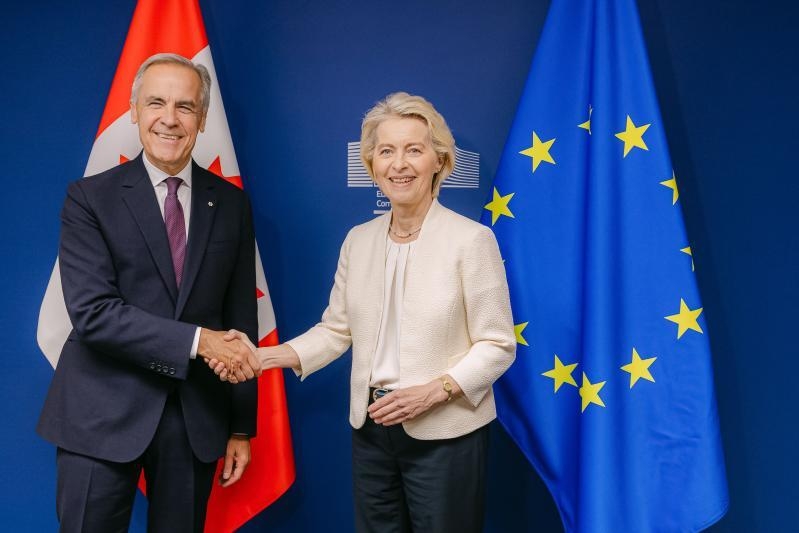
Brussels, 29 October 2026 – On the occasion of the EU–Canada Summit in Montréal on 29–30 October, EURATEX, the Canadian Textile Industry Association (CTIA) and the Canadian Apparel Federation (CAF) welcome the closer cooperation between the European Union and Canada. As a major contributor to the advanced manufacturing sector both in Canada and the EU, the textile and apparel industry has significant potential to strengthen this partnership.
The Comprehensive Economic and Trade Agreement (CETA), provisionally applied since September 2017, has laid a strong foundation for our growing trade relations. The potential for textile and apparel trade remains considerable: EU exports of textiles and clothing to Canada approached €997 million in 2025, while EU imports from Canada totalled €147 million. In the first six months of 2026, EU exports reached €702 million, growing by 5.7% compared with the same period in 2025. These figures reflect an established commercial relationship with significant potential for growth along the entire textile and apparel value chain.
For Canadian manufacturers, the European market offers important opportunities to expand exports, develop new commercial relationships and diversify beyond traditional markets. Canada’s textile and apparel industry brings significant manufacturing expertise, particularly in technical textiles, advanced materials and specialized products serving defence, healthcare, transportation, construction, and other industrial applications.
Further efforts are needed to ensure that companies, particularly small and medium-sized enterprises (SMEs), can make full use of CETA. The three associations encourage EU Member States that have not yet ratified CETA to complete their national procedures, enabling its full entry into force and ensuring long-term stability for textile and apparel businesses. The European Commission reports that the overall preference utilisation rate for EU exports to Canada rose from 38.7% in 2018 to 63.2% in 2024. While this represents significant progress, it also shows that eligible exporters are still not consistently claiming the available tariff preferences. Practical guidance must be clearly and simply communicated to ensure that more SMEs can take advantage of the agreement.
Equally important, Canadian manufacturers must be able to fully benefit from the opportunities CETA offers in the European market. Greater awareness of tariff preferences, simplified procedures and stronger connections between Canadian and European businesses would help unlock the agreement’s potential for companies on both sides of the Atlantic.
Our associations are already working to further deepen our relationship. In April 2026, EURATEX signed complementary joint policy statements with CAF at Première Vision Montréal and with CTIA at Techtextil Frankfurt. Through these statements, our associations committed to closer industry dialogue, stronger business relationships and cooperation on sustainability and innovation. The EU-Canada Textile and Apparel Dialogue, initiated by these statements, offers a platform to turn our shared priorities into concrete results, foster business-to-business partnerships and strengthen cooperation between Canadian and European manufacturers.
Looking ahead, EURATEX, CTIA and CAF support joint research and industrial partnerships in technical textiles, advanced materials, circularity, and recycling technologies. These areas offer significant opportunities to strengthen industrial competitiveness, develop innovative solutions, and create new value across the textile and apparel value chain.
We also encourage more coherent approaches to traceability, eco-design and digital product information, alongside regulatory cooperation, including the alignment of technical requirements and, where appropriate, mutual recognition of standards. Such cooperation would help reduce unnecessary regulatory burdens, particularly for SMEs, which make up most of our sector. Ensuring that regulatory frameworks support innovation, investment and industrial competitiveness will be essential to maintaining a strong manufacturing base in both Canada and Europe.
At a time of global trade uncertainty, the three associations underline the value of open, rules-based trade and resilient, diversified supply chains.
EURATEX, CTIA and CAF invite EU and Canadian leaders to use the Summit to strengthen CETA implementation, facilitate business-to-business connections, support joint industrial projects and promote innovation. The three associations stand ready to work with governments and industry partners to translate this shared ambition into tangible opportunities for Canadian and European manufacturers, reinforcing the competitiveness, resilience and sustainability of the transatlantic textile and apparel industry.
About EURATEX: www.euratex.eu
About CTIA: https://www.canadatextiles.ca/
About CAF: https://www.caf-fcv.ca/
Picture: Copyright at European Union , 2026